
Business Robotics: 12 Use Cases Across Marketing, Hospitality & Enterprise
The most useful robots do more than attract attention. They take on defined work, improve consistency, reduce exposure to risk, and help people spend more time on judgment, service, and creativity.
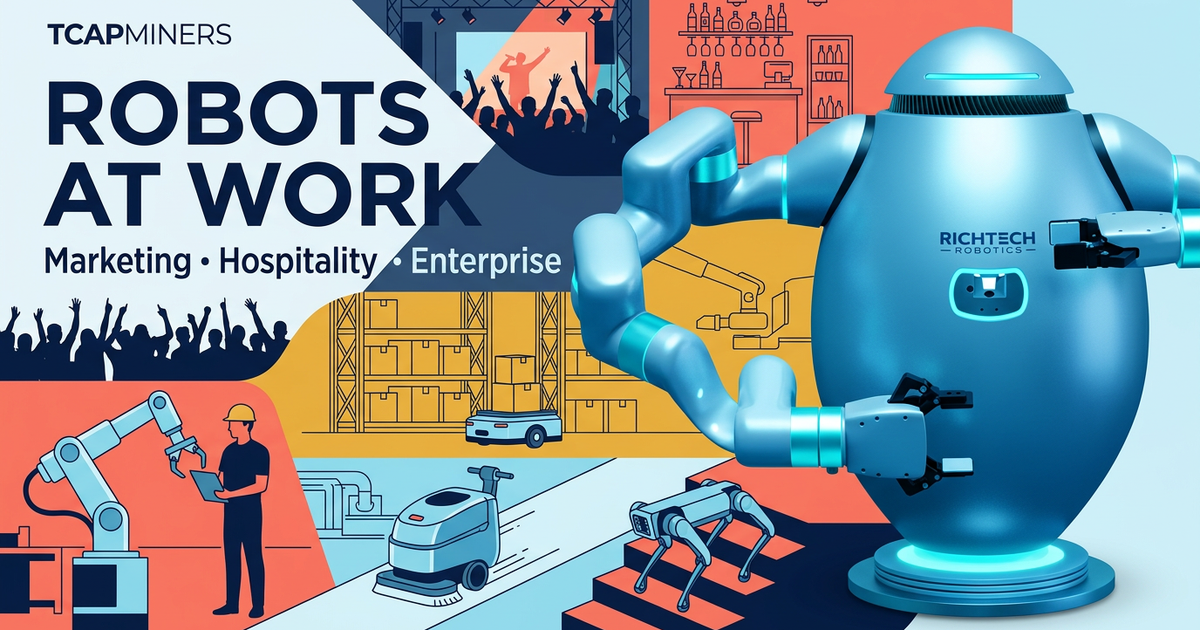
A successful robotics program starts with a measurable job—not a robot looking for one. Choose a repeatable workflow, define the human handoff, and measure throughput, safety, customer response, and reliability.
Experiential marketing
Robots become part of the campaign itself—drawing a crowd, creating an interactive moment, and giving visitors a reason to stay, participate, and share.
Customer operations
Service robots take on repeatable delivery, food-running, wayfinding, and inventory tasks while employees focus on higher-value customer interactions.
Workplace operations
Industrial robots, cobots, autonomous vehicles, and wearable systems reduce repetitive movement and limit human exposure to hazardous environments.
1. Experiential marketing and promotional events
At a trade show or branded event, attention is scarce. Robots can function as moving media: visible from across the floor, interactive at close range, and naturally suited to photos and short-form video. The best activations connect that spectacle to a useful visitor journey rather than treating the robot as decoration.
Humanoid brand ambassadors and greeters
Social robots such as Pepper, NAO, and guide robots can greet attendees through speech, gestures, and a screen. At events, they can answer a controlled set of questions, direct visitors, present a product menu, collect a lead through a QR code, or hand a complex request to a person.
Automated bartenders and baristas
Robotic beverage systems turn preparation into theater. Guests place an order through a kiosk or mobile interface, then watch a robot dispense, mix, or present the drink. Systems such as Makr Shakr demonstrate why this format works: repeatable service and a highly shareable brand moment occupy the same footprint.
Mobile product delivery and sampling
Compact service robots can circulate samples, drinks, or branded merchandise while carrying promotional content on an integrated display. Products such as KettyBot and Servi illustrate the category, although crowded-event deployment requires clear routes, speed limits, supervision, and an accessible fallback.
Telepresence for remote participation
A telepresence robot gives a remote executive, salesperson, or specialist independent movement and a face-level video connection. Unlike a fixed video call, the participant can move between exhibits and start informal conversations—useful when travel, accessibility, or scheduling prevents in-person attendance.
2. Customer-facing business and hospitality
In daily operations, novelty matters less than dependable service. Commercial robots work best on frequent, predictable routes where they reduce walking, carrying, or scanning without removing the human judgment a guest expects.
Hotel and hospitality delivery
Enclosed delivery robots can carry towels, amenities, food, and small supplies between a service area and a guest room. A mature installation may coordinate with doors, elevators, and guest notifications. The value is not replacing hospitality; it is removing a repetitive trip so staff can remain available to guests.
Restaurant food runners and bussers
Tray-based robots move prepared dishes from kitchen pickup points toward assigned tables and return used dishes to the back of house. They are most effective when servers retain ownership of greeting, recommendations, exceptions, and the final handoff.
Retail inventory intelligence
Autonomous inventory robots such as Simbe Robotics’ Tally move through aisles and capture shelf conditions. Their computer-vision output can help teams identify gaps, misplaced products, and label inconsistencies, turning a slow manual audit into a more frequent exception-based workflow.
3. Workplace and enterprise operations
Warehouses, factories, campuses, and infrastructure sites present the strongest economic case for robotics: high task volume, measurable cycle times, repetitive physical work, and environments where distance from a hazard has direct value.
Warehouse fulfillment and logistics
Automated storage and retrieval systems move bins, shelves, or individual items toward a person or robotic picking station. Grid-based systems such as AutoStore and floor-based mobile fleets reduce non-productive walking and allow operators to concentrate on picking, packing, quality control, and exception handling.
Collaborative robots in manufacturing
Cobots are designed for appropriately assessed collaborative applications, but “collaborative” does not mean risk-free. With suitable tooling, guarding, speed limits, and controls, they can assist with screwdriving, machine tending, inspection, testing, dispensing, and lifting while people handle variation and decisions.
Automated facility care
Autonomous scrubbers, sweepers, and vacuums cover large, mapped areas in airports, convention centers, warehouses, and office campuses. They offer the clearest return where cleaning routes are repetitive and the team needs verifiable coverage during quieter operating hours.
Wearable industrial exoskeletons
Passive and powered exoskeletons support the body rather than moving independently. In logistics, construction, and manufacturing, they may help reduce fatigue during repetitive lifting or overhead work. Any rollout should be evaluated by ergonomics and safety teams for the exact worker, task, fit, and environment.
Hazardous inspections and operations
Quadruped robots such as Boston Dynamics’ Spot can carry cameras and compatible sensing equipment through industrial sites. Remote visual, thermal, acoustic, or gas-monitoring missions can help teams inspect difficult areas and gather information before sending a person into a potentially hazardous zone.
How to choose the right robotics use case
Start with the workflow and operating environment, then evaluate a robot. A strong first deployment usually has a stable route, frequent repetition, a clear completion event, and a human owner for exceptions.
- Define one job in measurable terms: deliveries per shift, aisle scans per day, square feet cleaned, or inspection rounds completed.
- Map the environment, including people, doors, elevators, thresholds, Wi-Fi gaps, charging locations, and emergency routes.
- Specify the human handoff: who loads, unloads, monitors, cleans, resets, or takes over when conditions change?
- Measure total operating cost—not just purchase price—including integration, training, service, connectivity, consumables, and downtime.
- Run a limited pilot with success and stop criteria before expanding to more sites or workflows.
Safety, privacy, and accessibility come first
Robots that move around employees or customers need a documented risk assessment, trained operators, accessible alternatives, and a clear data policy. Cameras, microphones, badges, and analytics should collect only what the deployment needs, with visible notice and appropriate retention controls.
The business case: augmentation before replacement
The strongest robotics programs redesign a workflow around the strengths of both machines and people. Robots deliver repeatability, reach, sensing, and endurance. People bring empathy, improvisation, accountability, and judgment. When those roles are explicit, robotics can improve output and safety without degrading the experience for employees or customers.
Explore the current commercial and industrial robot lineup, or read how the broader AI infrastructure market is supporting physical AI and intelligent automation.