Compute Futures: AI Power Becomes a Tradable Asset Class
CME Group and Silicon Data are about to give GPU hours a public reference price — the way oil, gas and power already have one.
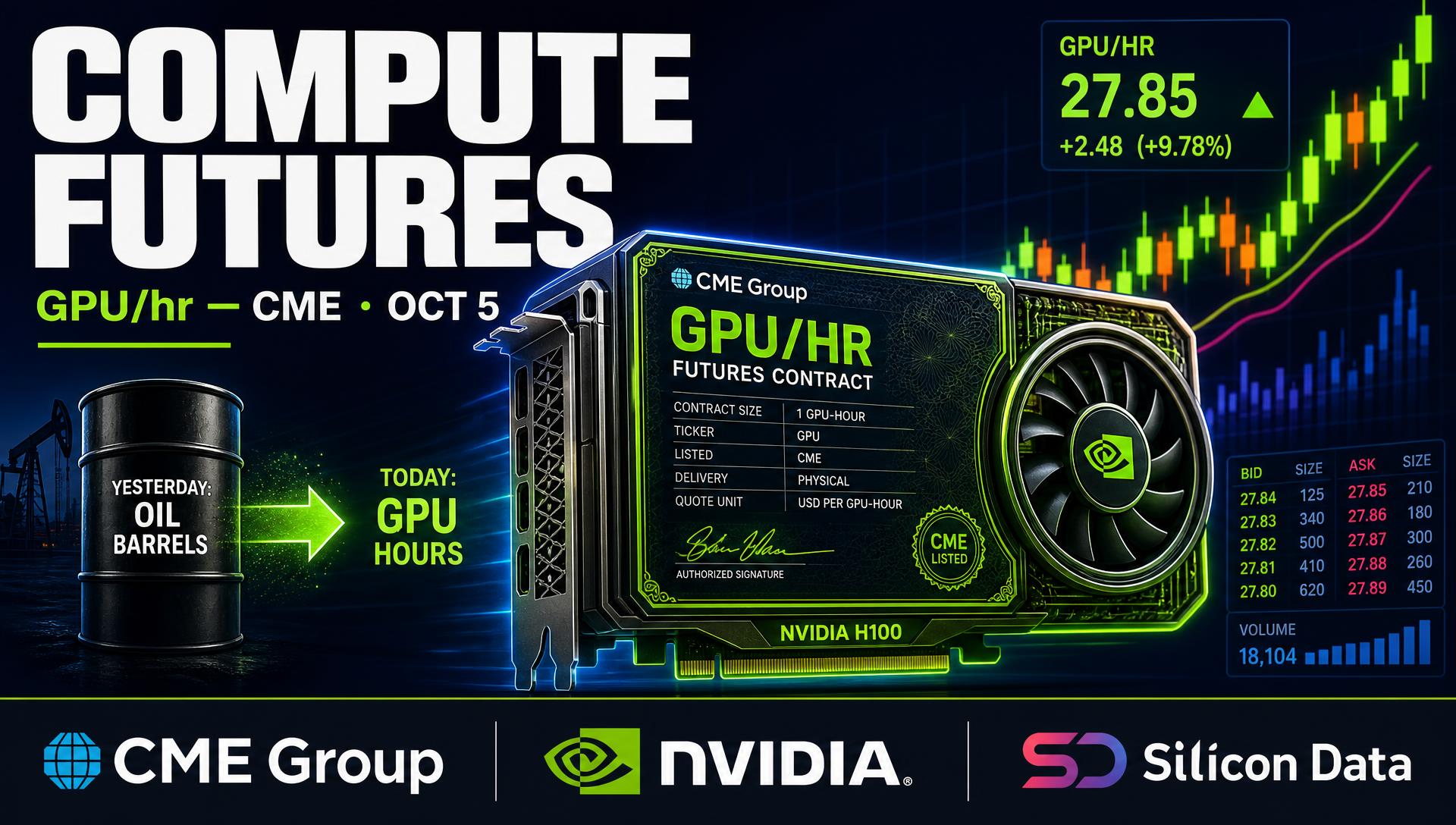
CME Group is launching two futures contracts tied to the cost of renting AI compute. For the first time, buyers and sellers of GPU capacity get a public, tradable benchmark — and a way to hedge it.
What CME is actually listing
October 5, 2026, pending regulatory approval.
Two compute futures contracts from CME Group in partnership with Silicon Data.
Hourly rental prices for NVIDIA H100 and Blackwell B200 GPUs, tracked by Silicon Data indexes.
One contract represents a month's rent for an NVIDIA H100.
Why a benchmark matters
GPU rental pricing has been famously opaque. Two companies could sign for identical H100 capacity in the same quarter and pay wildly different rates, with no public index to check either deal against.
"Compute futures give the market something it's never had: a public, tradable reference price for the resource every AI system runs on." — Carmen Li, CEO, Silicon Data
That's exactly how crude, natural gas and electricity matured. Once a settlement index exists, procurement teams negotiate against it, lenders underwrite against it, and a derivatives market forms on top of it.
Who uses these contracts
- AI developers locking in the cost of training and inference capacity months ahead of a model run.
- Data-center and GPUaaS operators hedging revenue when spot rental rates soften.
- Investors seeking exposure to the AI buildout without owning chips, real estate or equity in a single operator.
- Financiers pricing GPU-backed debt against an observable forward curve instead of a private quote sheet.
Part of a much bigger financialization wave
The launch lands as Wall Street builds an entire financing stack around AI infrastructure — including NVIDIA's reported work with major asset managers on an effort that could channel as much as $500 billion into data-center capacity. Compute futures add the missing price layer to that ecosystem.
For anyone who lived through crypto mining's hosting-contract era, the pattern is familiar: hashprice indexes and hashrate forwards did the same thing for Bitcoin miners. Compute futures are that idea, applied to the far larger AI market.
What to watch next
- 1Regulatory sign-off ahead of the October 5 launch date.
- 2Early open interest and liquidity — a benchmark only works if the contract actually trades.
- 3Whether the H100 index or the Blackwell B200 index becomes the market's primary reference as older silicon depreciates.
- 4How quickly GPU cloud providers start quoting index-linked contracts instead of flat hourly rates.
If you're budgeting an AI cluster right now, the practical takeaway is simple: your compute cost is about to become a market price. Model it like one.