
The Great GPU Server Boom: Inside the AI Hardware Arms Race
Liquid-cooled racks, photonic interconnects, and a memory crisis powering the biggest infrastructure build-out in history.
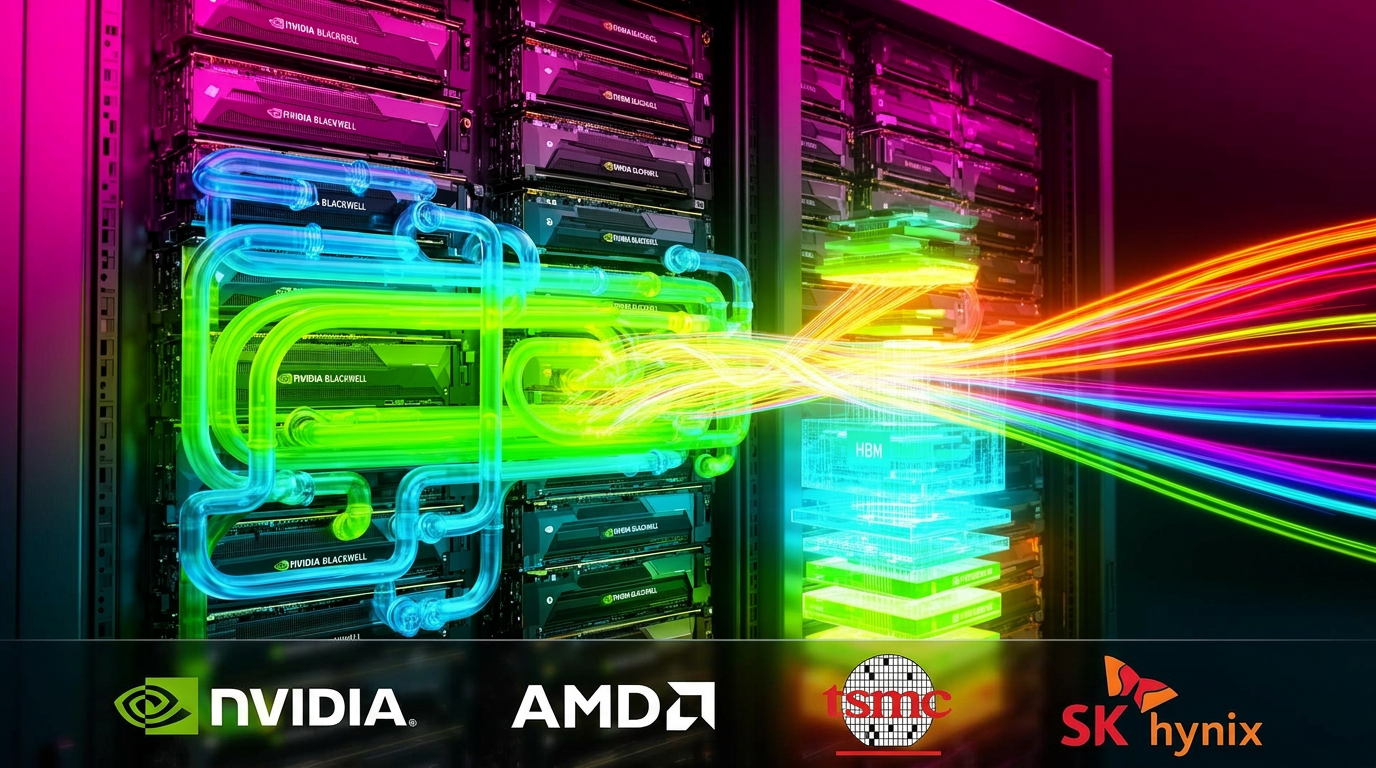
Enterprise AI is reshaping the entire server market. Racks are getting denser, cooling is going liquid, interconnects are going optical, and supply is going sideways — even as small teams quietly stitch together GeForce-based clusters to dodge the bottleneck.
A market rewritten by AI
The GPU server market isn't growing — it's mutating. Enterprise AI demand has forced every layer of the stack to evolve at once: chip packaging, board design, rack geometry, cooling, networking, and even how servers are sold. The unit of competition is no longer a card. It's a fully integrated, liquid-cooled, photonically-linked compute system that arrives on a truck.
Below are the five shifts reshaping the industry right now.
5 shifts driving the boom
NVIDIA isn't just selling GPUs anymore — it's shipping fully integrated AI server systems and rack-scale platforms (think NVL72) straight to hyperscalers. The unit of sale moved from a card to a cabinet.
Co-packaged optics push high-speed connectivity directly into the chip package. The payoff: lower latency, fewer cables, and the bandwidth needed for thousand-GPU training jobs to behave like one machine.
AMD's MI350P loads massive amounts of HBM3E onto a single enterprise accelerator, attacking NVIDIA where it hurts: memory capacity for huge model contexts. Custom silicon from hyperscalers is doing the same.
Even with record earnings, the industry is still rationing high-end GPUs and wrestling an HBM memory crunch. U.S. export controls keep tightening — and investigators keep finding smuggled racks heading into restricted regions.
Tier-1 servers cost millions, so engineers are stitching together efficient mid-scale GPU servers out of consumer GeForce RTX cards — trading peak performance and warranty for availability and 10× lower capex.
Why density and cooling are the real bottleneck
A modern AI rack can pull 100–250 kW. Air cooling falls apart long before that. Direct-to-chip liquid loops, rear-door heat exchangers, and full immersion are no longer exotic — they're the only way to keep a Blackwell-class rack in spec.
- Ultra-dense racks — 72+ GPUs behaving as a single accelerator.
- Liquid cooling standard — water, glycol, or two-phase dielectric.
- Co-packaged optics — bandwidth that copper physically cannot deliver.
The supply & geopolitics tax
Even with record revenue, top-end GPUs are still on allocation. HBM3E memory is the real choke point — yields are improving but demand is improving faster. Layered on top: U.S. export controls keep tightening, and enforcement agencies keep intercepting shipments of high-end AI servers being routed into restricted markets through grey-market resellers.
When the flagship rack is back-ordered for 18 months, "good enough, today" beats "best in class, someday."
The GeForce escape hatch
That's why we're watching a quiet boom in smaller, scrappier GPU servers built from consumer GeForce RTX cards. They lack NVLink scale, ECC memory, and data-center support contracts — but they're available, an order of magnitude cheaper per FLOP, and more than enough to fine-tune mid-sized models, host inference, or stand up a private compute cluster.
- • In stock, ships this week, not next year.
- • ~10× cheaper $/TFLOP than enterprise SKUs.
- • Great for inference, fine-tuning, and dev clusters.
- • No NVLink fabric for true multi-GPU scale.
- • Less memory, no ECC, no enterprise warranty.
- • Power and cooling design is on you.
What to do about it
If you're sizing AI infrastructure right now, the playbook is converging on a hybrid: reserve scarce top-tier capacity (NVIDIA HGX, AMD MI-series) for training; cover everything else — inference, RAG, experimentation — with denser, cheaper alternatives you can actually buy today.