
NVIDIA RTX Spark: Arm + Blackwell Lands in Copilot+ PCs
A 20-core Arm CPU, a Blackwell GPU, 128 GB of unified memory, and 1 petaflop of AI — all built for the next generation of on-device agents.
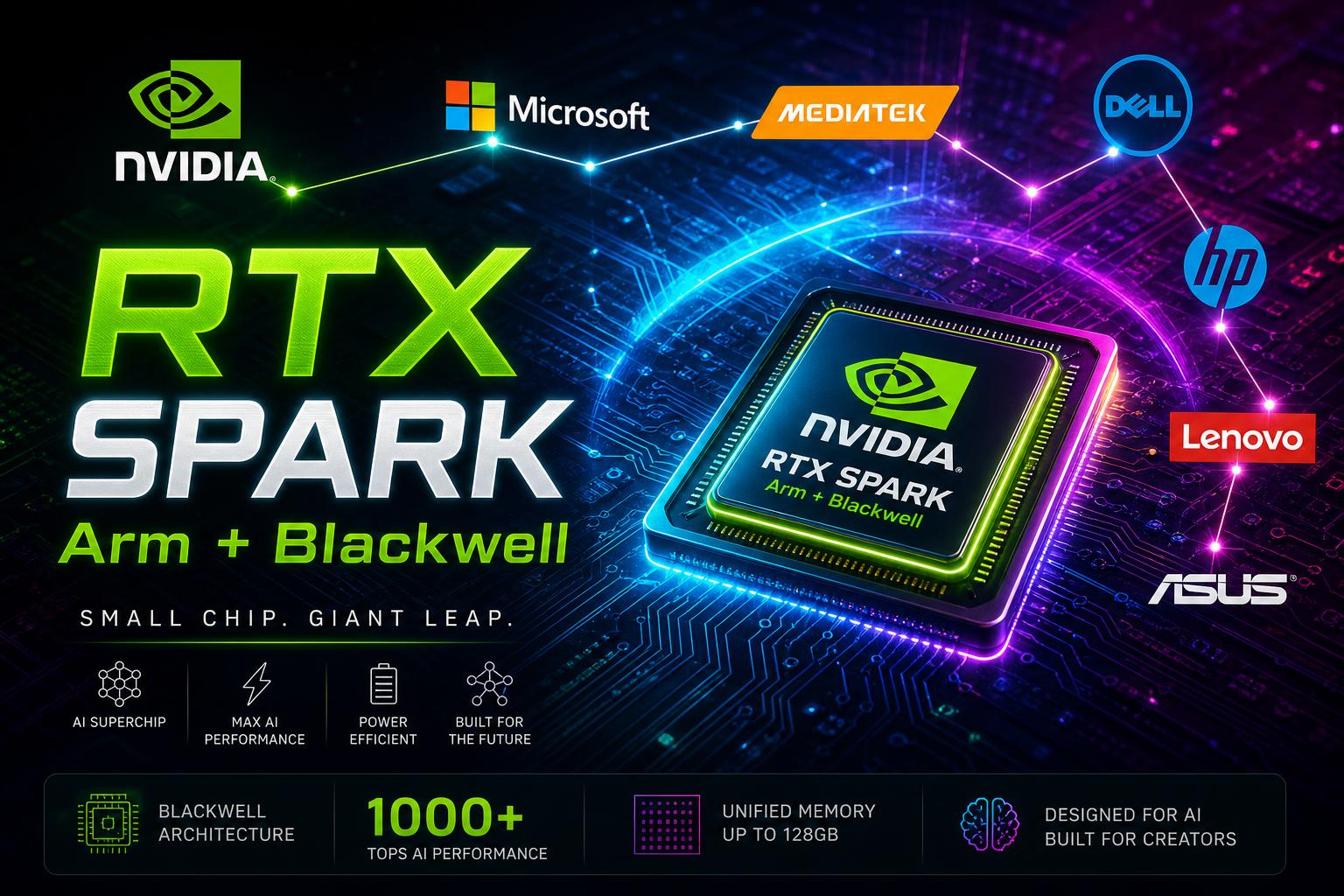
NVIDIA's RTX Spark is a new Arm-based superchip built with MediaTek and Microsoft for Windows Copilot+ PCs. It pairs a custom 20-core Arm CPU with a Blackwell RTX GPU over NVLink, ships with up to 128 GB of unified memory, and delivers 1 petaflop of AI in a chassis thin enough for a 14-inch laptop. Devices arrive fall 2026.
Acer and Gigabyte models are expected to follow the launch wave.
What the RTX Spark actually is
The RTX Spark is NVIDIA's first serious push into the Windows-on-Arm world — a single package that fuses a custom 20-core Arm CPU (co-designed with MediaTek) to a Blackwell RTX GPU over a high-bandwidth NVLink fabric. Think Apple-style system-on-chip integration, but with discrete-class NVIDIA graphics riding shotgun.
The headline number is 1 petaflop of AI compute from 6,144 CUDA cores, manufactured on TSMC's 3nm node and packing 70 billion transistors — all targeted at 14- to 16-inch laptops and mini PCs.
The four pillars
A 20-core Arm CPU stitched to a Blackwell RTX GPU over NVLink — discrete-class GPU bandwidth on a thin-and-light die.
Up to 128 GB shared between CPU and GPU. Load and run frontier-scale local models (up to 120B params) without ever paging to disk.
6,144 CUDA cores on TSMC's 3nm node — petaflop-class AI in laptops engineered for fanless and ultraportable chassis.
Optimized for continuous, 24/7 autonomous AI agents that live on the device — not in a metered cloud.
Full specifications
Why "agent-first" matters
The Spark isn't being pitched as another faster chip for Photoshop or Premiere. NVIDIA, MediaTek, and Microsoft are openly aiming it at continuous, 24/7 autonomous AI assistants running directly on your machine — reading your screen, drafting your email, scheduling your day, automating your tools.
With 120-billion-parameter models able to live entirely in the chip's unified memory, those agents stay local. That means three things people actually care about:
Your data never has to leave the device.
No token bills, no API quotas, no rate-limit walls.
Local inference, no round-trip to a data center.
When you can buy it
First RTX Spark devices are slated to ship in fall 2026. The launch lineup is broad: Microsoft Surface, Dell, HP, Lenovo, ASUS, and MSI are all expected on day one, with Acer and Gigabyte models following.
The RTX Spark is the first PC chip that treats an autonomous AI agent as the default workload — not a feature, not a sidecar, the workload.
What it means for AI infrastructure
On-device petaflops don't replace data-center GPUs — they offload them. Expect a clean split: the heaviest training and frontier inference stays on HGX B200/B300 racks, while everyday agentic workloads (email triage, code assist, document analysis, browser automation) move to the edge, onto Spark-powered laptops.
For operators running GPU servers, that's a tailwind, not a threat. Local agents drive more orchestration, more fine-tuning runs, and more retrieval pipelines — all of which still land on enterprise GPU infrastructure.