Why Zcash Mining Out-Earns Bitcoin Per Kilowatt
Lower difficulty, leaner ASICs, and a shielded edge on profit margin.
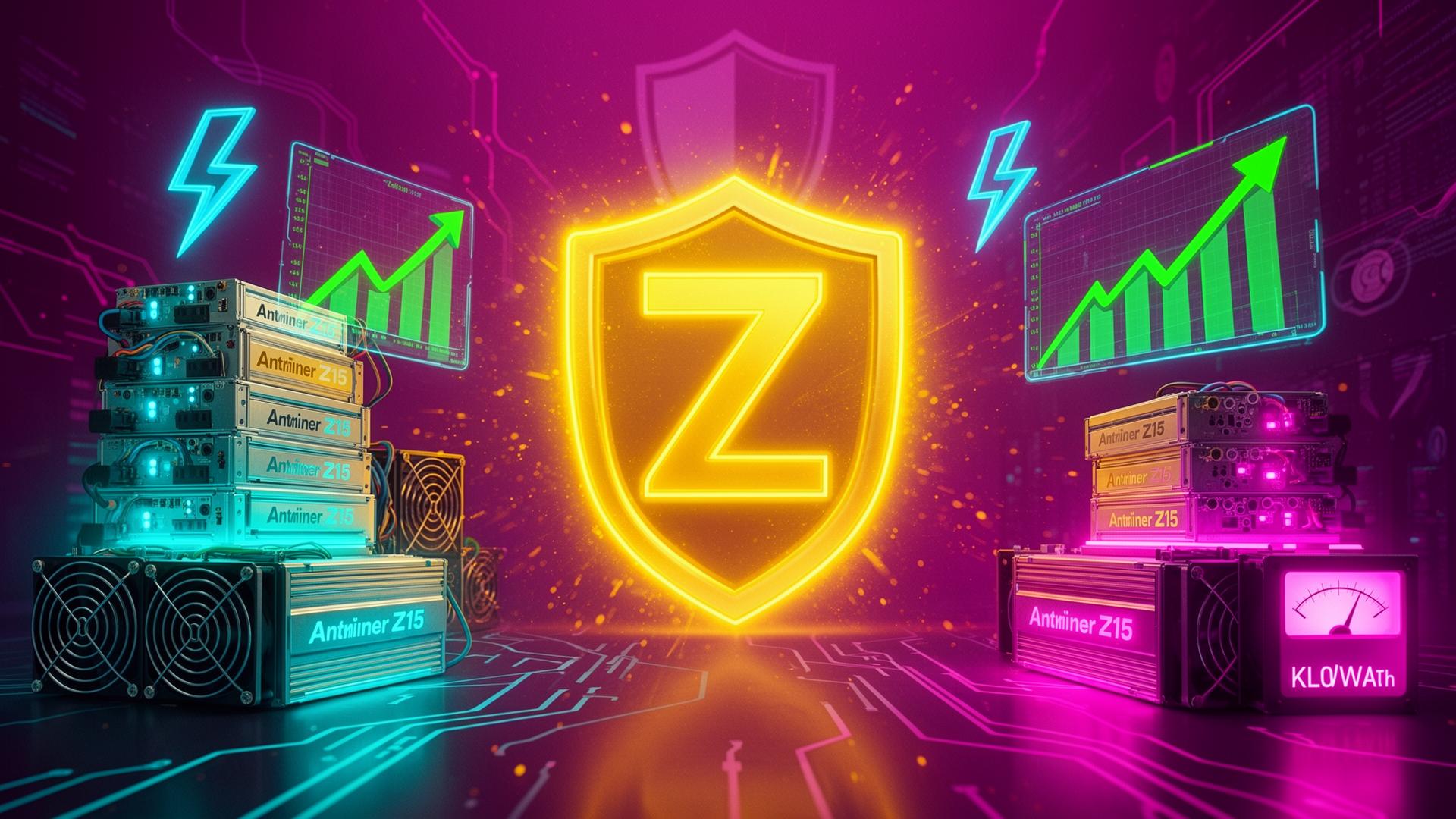
Zcash mining is widely considered more lucrative and significantly more power-efficient than Bitcoin mining — driven by lower network difficulty, better reward economics, and purpose-built Equihash ASICs.
The Bitcoin profit squeeze
Bitcoin's network is the most saturated in crypto. Hashrate sits at all-time highs, post-halving block rewards are halved again, and the cost-per-TH war is brutal. For small and mid-sized operators, BTC margins increasingly depend on near-free power.
Zcash sits in a very different place on the curve. The network is meaningfully smaller, demand for privacy settlement is structural, and the per-rig economics often look closer to what Bitcoin felt like cycles ago.
Three factors that drive the difference
Zcash requires less computational power to secure than Bitcoin, producing a significantly lower cost-per-reward ratio than the highly saturated SHA-256 network.
Zcash miners often generate higher returns per kilowatt-hour thanks to more favorable reward dynamics and highly optimized Equihash rigs.
ASICs like the Antminer Z15 series carry an upfront cost, but typically deliver a faster ROI and higher relative margins than industrial-scale Bitcoin gear.
The hardware that makes it work
You can't mine Zcash profitably with GPUs anymore — Equihash is dominated by specialized ASICs. The Antminer Z15 series remains the reference rig, prized for its hashrate-per-watt and predictable thermals.
- Purpose-built for the Equihash algorithm — no wasted silicon
- Far better hashrate-per-watt than repurposed Bitcoin gear
- Higher upfront cost, but typically faster ROI than BTC ASICs
- Compact footprint — friendly to small and mid-scale farms
A word on volatility
Higher margins come with higher risk. Zcash is a privacy-focused asset with a noticeably more volatile price profile than Bitcoin. Liquidity is thinner, regulatory headlines can move the chart, and a great week mining can be erased by a bad week trading.
Higher reward per kilowatt is only an advantage if you've already done the math on your kilowatt cost.
Run the numbers before you buy
Before committing to expensive mining hardware, do two things:
- 1Calculate your true delivered electricity cost (including cooling and overhead, not just the headline kWh rate).
- 2Check live network yields with a tool like the CoinWarz Mining Calculator so you're modeling today's difficulty — not last quarter's.
If the spread between your power cost and the live Zcash yield stays comfortably positive across a range of price scenarios, the case for adding a Z15 fleet to your operation is hard to ignore.